Building Strong Foundations: Early Childhood Education That Matters
April 29, 2026
In Kindergarten, understanding often begins before a child can fully explain an idea in words.…
In Kindergarten, understanding often begins before a child can fully explain an idea in words. At this stage, children are constantly making connections between what they see, hear and experience, which is why visual learning, movement and dramatic play can be such useful parts of teaching when they are brought together within the same lesson.
Visual learning gives children something concrete to connect a new idea to. A photograph, picture book, object or classroom display can help a child recognise something before they are expected to describe it. Take an animal they may never have encountered in real life. Seeing a picture of a giraffe immediately gives them details to notice, from its long neck and markings to its shape and size, while hearing its name begins connecting the image with language.
Those observations can naturally lead into conversation. A child may point out something they recognise, compare one animal with another, repeat a new word or ask a question about what they see. Vocabulary develops within a context that already makes sense to them, giving new words a clear connection to something they can identify.
Seeing an idea is often only the beginning. When children are invited to act out what they are learning, that idea becomes something they can physically explore. They may stretch upwards like a giraffe, stomp like an elephant, slither like a snake or imitate the sounds different animals make.
This is where dramatic or kinesthetic learning adds another dimension to the experience. Movement involves coordination and body awareness, while pretend play gives children room to use their imagination and express what they have understood. The visual reference, sound and movement reinforce the same idea in different ways and give children several ways to engage with it.
These activities can also become shared learning experiences. During dramatic play, one child may take the lead while another watches for a moment before joining in. As they participate, children notice what their classmates are doing, share space, wait for turns and respond to one another. A lesson centred on one topic can therefore support communication and participation at the same time.
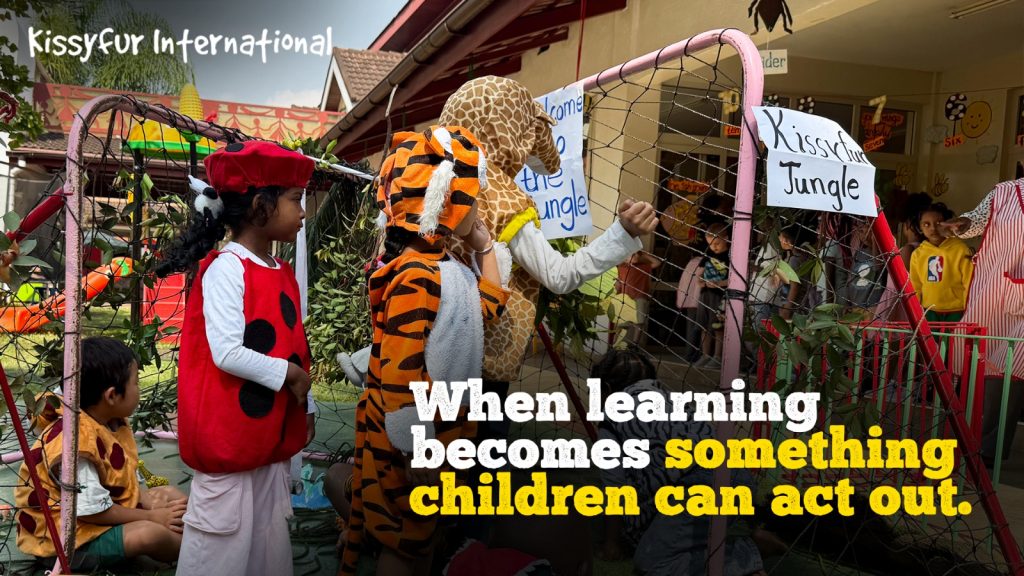
During one of our recent classes at Kissyfur International School, the children were learning about animals found in the jungle. After seeing and talking about the different animals, each child dressed as one of them, imitated its sound and acted out how it moves.
That simple progression helped bring the lesson together in a practical way. An animal became more than a picture or a name to remember. It became something the children could recognise, describe and physically explore through play. Within the same activity, they were building vocabulary, observing differences, recalling information, using their bodies and interacting with one another.
At Kissyfur, this is one of the ways we introduce new concepts during the early years. Children do not all connect with an idea in exactly the same way. One may remember the picture they saw, another the sound they made, while another may recall the movement they performed alongside their classmates. Giving children different ways to experience the same concept creates more opportunities for those connections to form.
Parents may sometimes notice the learning later in very ordinary moments. A child recognises an animal in a book, repeats a sound at home or suddenly demonstrates a movement they practised in class. These small moments can show that the experience stayed with them long after the activity ended.
In kindergarten, learning can become easier to remember when children have the opportunity to see an idea, hear it, explore it through movement and make it part of an experience of their own.