What Career Day Reveals About How Children Begin to Shape Their Future
April 29, 2026
A child absorbed in water play may appear to be enjoying a simple moment with…
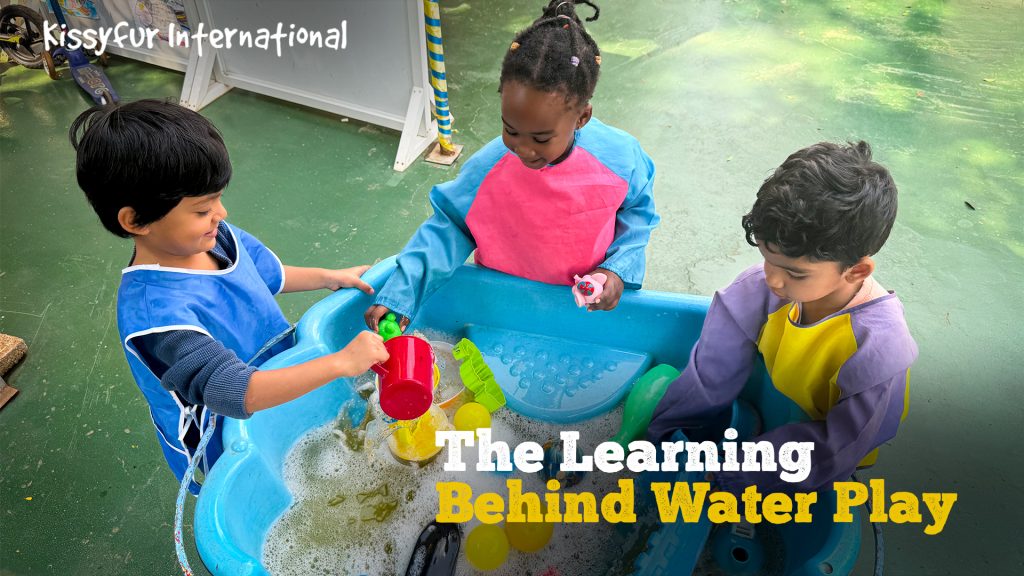
A child absorbed in water play may appear to be enjoying a simple moment with cups, funnels and containers. Yet within that experience, they may be strengthening their hands, testing an idea, learning new words and finding ways to cooperate with the children around them.
The learning can be easy to overlook because it unfolds so naturally.
In an early years setting, water play gives children suitable materials and enough time to explore how water moves, changes and responds to their actions. They may scoop, stir, squeeze, carry, fill and empty while a teacher introduces a question, adds new vocabulary or encourages them to observe what happens next.
These familiar actions support physical development in meaningful ways. Pouring carefully from one container to another strengthens hand-eye coordination, while squeezing sponges and handling small tools develops the muscles in the hands and fingers. Carrying buckets and moving larger containers also involves balance, control and the larger muscle groups children use throughout the day.
Water play also gives children many opportunities to think through what they are doing. They notice that some objects remain on the surface while others sink. They compare containers, explore how much each one can hold and begin to understand that water behaves differently depending on how it is moved.
Through these experiences, early ideas about cause and effect, capacity, volume and weight begin to take shape. When something spills or an object behaves differently from what a child expected, they are encouraged to observe, adjust and try again. This process supports problem-solving because children are learning to respond to what they discover.
Language develops alongside the activity. Words such as full, empty, heavy, light, more, less, floating and sinking become easier to understand when children can connect them to a real experience. Conversations with teachers and classmates also help them explain what they notice, listen to other ideas and express their own thinking more clearly.
Water play often becomes a shared experience. Children take turns, pass tools to one another, make room around the activity and sometimes work together towards the same small goal. These moments help them practise patience, communication and cooperation in a setting that feels familiar and enjoyable.
The sensory quality of water can also bring a sense of calm. The repeated rhythm of scooping, pouring and stirring gives children something steady to focus on and allows them to take part at a pace that feels comfortable.
At Kissyfur International Kindergarten and Day Care Center, water play forms part of a daily programme that is rich in variety and carefully structured to nurture creative growth through exploration, activity and play.
Our programme is based on the play-way method for preschool education, which recognises that young children build understanding through active participation. Teachers prepare the environment thoughtfully, introduce suitable materials and guide children with questions that encourage them to notice, think and discover.
For parents exploring an international nursery school or an international kindergarten in Uganda, everyday activities can reveal a great deal about how children are supported. The value is often found in the quality of the environment, the role of the teacher and the time children are given to explore an idea fully.
Families considering preschools in Kampala may see water play as one example of how early learning can be woven naturally into a child’s day. At our Kampala and Entebbe branches, experiences like these help children develop physical, cognitive, social and language skills within a programme shaped around the way young children learn.
For a parent searching for a nursery school in Kampala, Uganda, the smallest classroom moments can often say the most. A child working carefully with water may be building coordination, testing a possibility, learning to wait for a turn or finding the confidence to try again.
Water play may seem simple from a distance, yet for a young child it can bring movement, language, discovery, cooperation and calm into one meaningful experience.