How to Choose a Kindergarten in Kampala: A Parent’s Checklist
October 13, 2026
Ask a group of adults what they remember from nursery school, and most will not…
Ask a group of adults what they remember from nursery school, and most will not talk about worksheets or classroom routines. They are far more likely to remember planting a seed, baking something with their classmates, or holding a tiny chick for the first time.
There is a simple reason for that. Young children make sense of the world by experiencing it.
Research in early childhood education has consistently shown that children learn best when they can actively engage with what they are learning. Seeing, touching, listening, asking questions, and making discoveries for themselves helps them build stronger connections than simply being told what something is. For children in their preschool and nursery school years, learning is not separate from doing. The two naturally belong together.
This is one of the reasons hands-on learning remains such an important part of quality early years education. A story about the life cycle of a bird can certainly capture a child’s attention, but watching that same journey unfold over time creates a different kind of understanding. It encourages observation, patience, conversation, and curiosity all at once.
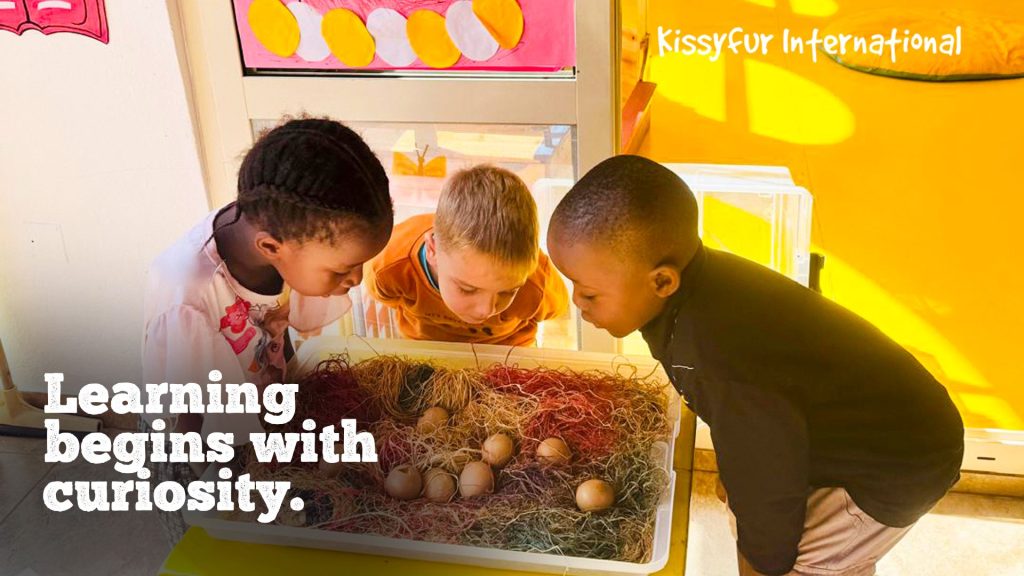
One of the recent classroom topics at Kissyfur International School was the life cycle of a bird. Over a period of 21 days, the children watched eggs resting in an incubator, wondered what was happening inside, and counted down to the moment the chicks would finally hatch.
When the chicks eventually hatched, the lesson was no longer something from a picture book or a classroom discussion. The children were seeing something they had been learning about come to life right in front of them. The excitement came naturally because they had been part of the journey from the beginning.
Moments like these often stay with children long after the details of the lesson fade. They also create opportunities for language development as children describe what they see, social development as they share the experience with friends, and confidence as they ask questions and make their own observations.
For parents, it can sometimes be easy to measure learning by what comes home in a school bag. A completed worksheet or a piece of artwork is visible proof that the day was productive. Yet some of the most meaningful learning leaves no paper trail at all. It lives in the stories children tell at the dinner table, the questions they ask on the drive home, or the excitement they carry into the next school day.
That is why hands-on experiences continue to matter in an international nursery school and preschool environment. They help children connect ideas with the world around them and encourage a genuine love of learning from an early age.
At Kissyfur International School, learning is often built around these opportunities for discovery. Whether children are exploring nature, experimenting with simple activities, or watching a lesson unfold before their eyes, the goal is not simply to provide information. It is to give young learners the chance to experience it for themselves.
Perhaps that is what makes the early years so important. Children are not simply collecting facts; they are making sense of the world around them. When learning becomes something they can experience for themselves, it often stays with them long after the moment has passed.